

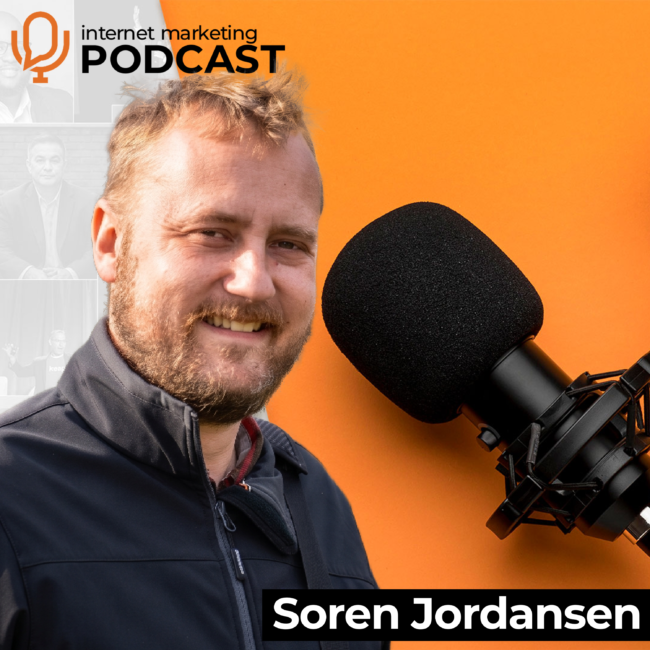
About this Podcast:
Today’s guest is Soren Jordansen, better known to many as The Copy Viking. For more than two decades, Soren has been writing high converting copy, creating successful digital products, and helping entrepreneurs communicate more effectively. And rather than standing still, he’s also continued to evolve with the industry, embracing AI, publishing, and also entirely new business models. I’m excited for this.
Episode Transcript:
Editor:
Today's guest is Soren Jordansen, better known to many as The Copy Viking. For more than two decades, Soren has been writing high converting copy, creating successful digital products, and helping entrepreneurs communicate more effectively. And rather than standing still, he's also continued to evolve with the industry, embracing AI, publishing, and also entirely new business models. I'm excited for this. Soren, welcome.Søren:
Thank you very much. Pleased to be here.Editor:
You've been in marketing, as I mentioned, for over 20 years, but how did it all begin?Søren:
Yeah, that's a funny story, actually. I'm based in Denmark and I was in the army. I was an officer in the Danish army, first lieutenant, platoon commander in Danish artillery, actually air defence. I did my tours around the world and all that. Soldiering is a lot about waiting, whether you're deployed or you're at base. I noticed the thing, a lot of my fellow soldiers, they would spend a lot of time, back then, 20 plus years ago, gambling sites, poker sites, that was huge. And a lot of them, they would gamble. They would also watch, let's say, more colourful websites. We don't have to mention, but you get the idea. And all these sorts of things that soldiers do. One day I noticed something on one of these sites that was like become an affiliate at the bottom. Something clicked in my mind. I was like, wait a minute, all these guys are doing all this. You're telling me if they go through my link, I'll earn a percentage of everything they do. It was my first foray into it. And I did what any reasonable person would do. I went to local kiosk and bought a front page for dummies. Back then, you could build websites with Microsoft FrontPage, which I'm sure doesn't exist anymore. And I built a website and you imagine a GeoCities kind of website banner farm and I was very much in the build it and they'll come kind of mode. I built this website, I figured it all out on my own and it was a terrible affiliate website. Obviously never got a single visitor or anything. That led me to the famous Google search. I'm not even sure it was Google back then. It probably was just the start of Google, where I searched how to get traffic to a website. And then I found a forum, netmarketingforum.com, which also doesn't exist anymore. And from there, I got connected with people who were doing affiliate marketing, launching traffic exchanges, which was a big thing back then. And then I got in. So instead of doing this affiliate side, I then got into the traffic generation side of things, launch my own safe list, traffic exchange. That's where the copywriting came in because then I discovered that I actually had a knack for that. I always been good at writing this go, but I had a good active copywriting as well. So I wrote my own copy and it sort of evolved from there. Then I started, I had customers, I had members, then I did products, information products, then software products and along the lines. And always wrote my own copy and got better and better at it until people started also wanting to pay me to write their copy. We got quite big. I partnered up with a few people, John Merrick and Cindy Batty. We ran wealth builders, instant marketing wealth builders. We were the top vendors on JVC.com. We were pretty big on ClickBank as well, Warrior Plus. Yeah, so that's how I got started.Editor:
From day zero to where you are now, how long did it take maybe before you thought, "This is viable. This is something that I can do now. I can leave everything I've done before behind and concentrate fully on this"?Søren:
The famous, building the terrible website happened in 2004. And then, same year, finding out that it doesn't just magically come to you. And then I did this whole and started out. So that would be late 2004. So 2005 was a year where I built simultaneously with having my full-time job in the army. June of 2006 is when I went to the colonel's office and said, "Good day, sir. I would like to resign." Because at that point, I was making more money from the internet marketing than the army would ever pay me. So it took me year and a half to go full-time.Editor:
It's a great story that you have and obviously the internet itself has changed so much in that time. And I think a lot of people think it must have been easier back then to get started than it is today. What would you say? What's your experience of that, Soren?Søren:
Actually, yes and no. It was easy back then. We like to refer to it as the wild west of internet marketing. Anything goes, everything was new. We made it up as we went along, which made some things easier and some things a lot harder as well. It was easy in the sense that the bar was pretty darn low. People hadn't seen a lot of stuff yet. So that little idea you got turned into a product that could actually sell and a product that probably wouldn't sell today because people, they've seen it a million times. But I actually think we are right now at a point in time that is very similar to when I got into it because of AI. I think it's a little bit of a wild west situation now too because I love this because you have a very short path from idea to execution now because you can use AI to help you along the way, both for coding and writing and ideation and all that stuff. I don't need to employ a bunch of programmers necessarily or all the stuff that I eventually ended up having. So I think it's a little bit of both. Yeah, it might've been easier back then, but we didn't have AI. And if you gave me the two time periods as to which one would you prefer to start in, I would probably pick this one where I have the AI sidekick, but I do say that with the benefit of the hindsight and all the knowledge I have to get what I get out of AI. So I don't know, but I don't think it was particularly easier back then than it is now.Editor:
I think one of the things that strikes me most about you, Soren, is the way that you've reinvented yourself several times in that period. How important is it to be adaptable?Søren:
I think it's very important because in internet marketing, well, internet in general, things move really, really, really fast. What is the trend today will be potentially outdated next month, and that's always been the case. I've seen a lot of people come and go, and go because they did not reinvent theirself. They found something that worked and they kept doing it and then they stopped working and they still kept doing it and then they go out of business. And there's very few people who can do the same thing over and over again. Actually, the internet marketing newsletter is one of the very few examples of something that has been persistent for, I don't even know the number, but I think it's way over 15 years, I think, but that comes down to the quality of it. And they've also reinvented, Nick James reinvented it over the years, but for everyone else, yeah, you didn't need to keep it the times and you can't just keep doing the same thing. My reinvention was also... I did the marketing and we were at the top of the affiliate marketing world and the top ClickBank, the top of JVZoo and I think I got burned out and didn't want to do it anymore. So actually, I took a 10-year period where I went corporate. I've been doing marketing consulting and writing copy for hedge funds, pension providers and mostly in the States, all these big real estate investment funds and that sort of thing. Then I came back actually this year, 2026, to marketing. So that was also... Don't get me wrong, that was very boring to do that as well. You don't have the freedom that you have in internet marketing and it's much more rigid and there's a bunch of lawyers to check everything you do, but I do come back with a sharpened mindset because that is a cutthroat world when you have to write copy for one hedge fund to get investments over the next one. That is a lot harder than selling something on Warrior Plus or JVZoo. So I come back with a sharpened sword, so to speak. But I do love the world that I'm in now where I actually have the creativity and the freedom to execute and ideas from one day to another and don't have to ask 50 lawyers for permission.Editor:
And copywriting seems to be the thread that runs through everything that you've done. You are known as The Copy Viking. I'm guessing that's because of your roots being based in Denmark, but maybe you could just tell us about what makes good copy.Søren:
There's lots of things that come in today. Some would say I'm a dinosaur in this regard because I'm very much of the old school. I am of the school of Gary Halbert, John Carlton, Dan Kennedy. I do keep up-to-date with newer copywriters and stuff, but I am old school. For me, and this is one of John Carlton's main points is that what makes good copy is to finding a good avatar, define who you're writing to and then write to that person. What do they want? How do they consume what you put out there so you write to that person. But for me, I wouldn't say I'm a copywriter because 99% of the copy I have written in my... If we exclude this corporate venture, if we just do the internet marketing part of it, 99% of the copy I've written is for my own stuff, my own products, my own services. I have written for other people, but mostly for my own stuff. And I think for me, what makes me a good copywriter is having a product that is good and what I believe in and one that I believe will be beneficial for the customers. I'm probably atypical for a copywriter because I don't really enjoy writing copy for other people's products. I enjoy writing for my own products, and I tend to develop products that I would want to use, that I believe in, that I think are great. When I have that, I can go into a zone where I can write some really, really good sales copy. I can write and I have written a sales copy for... I think the most exotic I've done is like a knitting course, and I can write really good sales copy for that, but it's not as good as when I write about my own products. So I think for me, that is the key.Editor:
I guess that makes sense. And when you sit down to write copy, is it you open up Microsoft Word or a Word processor, or do you sit down with a piece of paper and a pen and start writing? Or do you define that avatar first? What's your process?Søren:
Well, because I mostly write for my own stuff, the avatar has been defined before I even create the product. So I will create the product to the avatar and then you write to the same... I used to be a pen and paper writer. I would write everything on pen and paper first before it would come into the computer. Now I'm more modern. I have Claude Cowork open and then I use speech to text products and I'll just talk to Claude and I will ramble off my notes and Claude will organise this into something. It's essentially the same process as my pen and paper back in the day is just I'm just speaking to the machine and the machine is doing the pen and paper bit. I mean, it's essentially the same.Editor:
I love the fact that you've embraced AI so much. It's opened up opportunities that simply didn't exist a few years ago. What about AI excites you the most?Søren:
Well, there's a lot of things that excites me, but what excites me is that... I don't use AI to replace myself. I use AI to enhance myself. So it's very much about doing what I've always done, but doing more of it and faster and more efficient. So that excites me, obviously, but it also excites me that AI has given me the opportunity to get an idea this morning and implement it this afternoon without having to go out and find a freelance programmer or something. We might hire someone to fine-tune or whatever, but you can go from idea to execution in minutes with AI and I think that is super exciting. As an example, in what we're doing now, my wife, who's also an internet marketer, and we actually met at a marketing conference in Manchester back in 2013 or something, she used to do the exact same thing I do. Now we just do it together, family-run business, but she is not a programmer, has never been, but she now runs the entire tech stack in our company. She codes everything. She uses Claude Code and she's been become really, really, really good at it. And she's built our custom membership side and all that stuff, and stuff that was just not possible before AI was there. Then the third thing that really excites me is that I can ask more of my customers because I know that I can teach them to enhance themselves with AI, which means I can actually do some much more advanced stuff, teach them and give them more advanced stuff that will work because it's based on them also enhancing themselves with AI.Editor:
A lot of people think with AI that it can replace a traditional copywriter, that you can sit down and say, "Write me a sales letter for this product," and off it goes and it will write the most perfect, wonderful sales page for you. How important is it to prompt, would you say?Søren:
Extremely, extremely important. I have a real world example for it. Actually, the reason I'm back in internet marketing now is that the company... I worked for a major American agency and they then had all these clients in the financial space. That pretty much went south because they had this fantasy about replacing a lot of people with AI and then we can just ask AI to do this. The quality just went down and everything went south and I could see the writing on the wall and I was pretty much made redundant maybe about my own choice, I don't know, and I got out. That's a case of wrong use of AI, because Claude and ChatGPT can be fantastic copyright as well, most AI can, but it will also enthusiastically give you the worst crap ever written and tell you that it's good copy. And if you don't have the knowledge to judge whether it's true or not, you're in the deep end. Now, I have the knowledge, so I can judge it, but if I do it unprompted and whatever, it's just a waste of time. So my copywriting is not just prompted. I built system prompts and personas and huge files for my AI to mimic what I want and how I write and is trained on everything I've done so that when AI assists me, what comes out is pretty much what I would've done and then we fine-tune, and then there's a conversation about fine-tuning. That's where I then enter the process. So essentially it's the same I've always done. It's just faster. Copywriters are threatened right now. I think it's hard to get a job as a copywriter. If you're on my sort of experience level, there is jobs if you embrace AI because everyone wants someone who can do it with AI. If you are new to copywriting, if you're a junior copywriter, usually, back in the day, you would start out with writing Amazon descriptions and stuff like that. That's completely eliminated. Everyone just uses AI for that. There's not many jobs for you. So that is a rough business, so if you are someone who wants to be a copywriter, the best thing I can tell you is become really good at writing copy with AI because if you don't have that, there is no work. My good friend, Matt Garrett, actually said it very well the other day, he said, "Because a lot of people are afraid that their jobs will be taken by AI." And I don't think that's true. Matt said it really well, your job's not going to be taken by AI. Your job's going to be taken by someone who uses AI.Editor:
I think one of the key points there as well is the fact that with all your experience, Soren, you still use AI as an assistant, not a replacement. And I think that's key because a lot of people are seeing it, particularly in the corporate world, as AI can replace people. But I think that you still need someone who's got experience and knowledge in a sector to be able to know whether or not the AI is giving you great quality copy or not, or great advice or not.Søren:
Yeah, absolutely. And I see it in the internet marketing space, and without mentioning any names or shaming anyone, but I do see a lot of products being launched where someone has obviously just asked AI to create a product and write a sales letter. And they do sell and they probably make some money from it, but I think that's a very short term cash crap and it's not sustainable and people will not want it because in a world where AI is becoming pervasive and most people use AI, they will notice when people just do that and the question becomes like, why did I pay 20 bucks or 100 bucks for this? I could've done this myself. Whereas I use AI in every step of my product creation, but again, it's to enhance me. I could probably have done everything I do in my products without AI, it would just have taken a lot longer. But if you buy something online, you will not get the feeling that I could've sat down and prompted AI and gotten this myself for free. And I think if you as a product creator in marketing, if you don't give that feeling, you're going out of business very soon.Editor:
I guess at the end of the day, it comes down to integrity as well, doesn't it? The integrity of your own product and also, you need to be proud of what you create and what you put out into the world. And if you're just relying on AI to provide you with that product, yet, as you say, you may make some money from it, but that's going to be a very short term view, and most people need longevity and a career from this. Talking of careers though, Soren, recently, you've launched products like Cosy Co-Author and Audio Dollars. Maybe you could just tell us a little bit about them and how they came about.Søren:
When I exited the corporate world and said, "I want to go back to internet marketing. I want to be my own boss again. I want to create stuff. I want to have the freedom. I want to do what I actually love doing," I had to pick a lane. Before, we used to create a lot of software products and like WordPress templates and WordPress plugins and that sort of stuff and it was more targeted towards your classic internet marketer, someone who needed traffic or leads or sales, still a valid market that a lot of people need, but I didn't want to go back into that. So I was looking and I came across self-publishing because there's a lot of self-publishing authors in the world and there's a lot of people who have ideas for books and stuff that they would like, but don't know how. And I love books, I love literature, I love reading, I love writing. So this was natural for me. So I made these products that basically is about teaching people how to write a book with AI either as writing it for you based on your idea or writing it with you. That's where the coauthor name comes from or just making the planning documents and very much as not a press a button and get a book because usually then you get something that might look impressive but is actually not very good. This is very much about getting quality that people would actually want to read and pay for. I came into this with the intention of, and I'm doing that, building products first for myself. So I built something that I want to use and am using to publish books and make money with them, and then if they're good enough, then I release them to the world. So that's where we as I'm... Yeah. And I have published, I think, now six books on Amazon that are selling. It's not big, but I think thousand dollars in royalties this year from Amazon, and is growing, and then I'm teaching other people how to do the same when you say I have to do it. I'm building and refining these products for myself and the members seem to like it. What I'm seeing now is I'm getting a lot of customers, and most of my active best customers, the one who engage with, they are not there necessarily for the silver bullet to make money online. They're there because they have a dream or an idea and they would like to turn it into a book and they need help. They're loving the process. They're loving seeing their ideas come to life, they publish books and whatever. The money is a secondary thing that, yes, we hope it'll make money, but they're more there for the experience, the feeling and the dream of making it happen.Editor:
Because you've moved into various different niches within publishing as well. Obviously you've got the books themselves. You've got audiobooks and also puzzle books as well.Søren:
Yeah, that was my very first product since coming back. There was a piece of software for making Sudoku books. Yeah, they're doing really well and people are publishing and they're making money with them. The product itself did not do as well as stuff that came after it precisely for the reason that I just stated here. So I came back and I figured, okay, people had done Sudoku puzzle maker software to make books to put on the Amazon KDP. I was like, "I can do that better. I can automate it even more. I can make it much more like you just click one button and you get a book that's all formatted and ready to upload." And it turns out, I think I took away part of that process and dream that people have about publishing and turn it into a press a button. Then what happens is I took all the fun out of it and then people just have a book and then they can operate to Amazon. And what happens when you upload to Amazon? Then it needs to start selling. And if it doesn't sell immediately, nothing sells immediately. It's a slow growth process. I took all the fun out of it, which I think is key. So that's probably why that didn't do it as well. We are developing now another puzzle book-making software, actually a membership site where you can do a lot more than Sudoku or whatever and that much more plays into being what the course you call offer system or whatever is where it teaches and it lets you play with stuff and do stuff and move stuff, giving that feeling that people also want because at the end of the day, this is not entertainment. This is about publishing and making money, but it should also be entertaining, if that makes sense.Editor:
Completely, absolutely. So Cosy Co-Author is definitely one to keep an eye on for the updates. You've got Audio Dollars as well. I guess that takes the idea of creating an audiobook and getting that onto the audiobook platforms. Is that right?Søren:
Yeah. Audio Dollars came about... We had a friend in marketing who actually doing the process, he identified that there was a real gap in the market because audiobooks as a whole is growing exponentially. People like to listen to books because they're on the road, they're on their lunch break, they're on the train, all that stuff. But there's a real gap in the market because most audiobooks are eight, 12, 24 hour listens. They're full books. And what a lot of people want is that 15 minute book for their lunch break or the one when they're trying to fall asleep or when they're on the train or when they're exercising or something like that, and those are missing. So this was about making the short 15 to 30 minute audiobooks, short stories in various genres that you then upload and then there's very much a volume play because one of those might make a few sense here and there, but they're quick to make and we have enough of them up there. It starts compounding. That's why we built the system helping people, teaching them how to do it and using AI to write them and turn out very popular. I love to see it. We get people who come back and say they're now getting royalties from Spotify and all these places for these audiobooks. And again, might be a few dollars here and there for a book, but it compounds and adds up.Editor:
I think for anybody who is listening to this or reading this who would like to follow you to find out more about you, Soren, and also the great range of products that you have, where do we need to go to find you?Søren:
Well, the easiest place to find me and find everything is my main website, which is thecopyviking.com. That's my hot page. From there, there's links to everything I do. There's blogs on there, everything. So that's like the main hub where you'll find me. And I would just like to say I am not hard to find either because I am blessed and cursed with a name that is rather unique. Jordansen is our family name and it's a rather unique one. There's 89 of us in Denmark and a few Norway and probably a few in the States that immigrated way back, but basically, our family is the only one in the world with this name and there's two of us who's called Soren, me and a cousin. So if you search for Soren Jordansen, you're getting either me or my cousin. I can't hide. So you can go find everything I've ever done online if you really want to. Most of the old products, they're discontinued, they're sold, they're closed or whatever. Thecopywacking.com only has the new stuff, but if you're interested, I'm really not hard to find. I can't hide anywhere.Editor:
Well, it's really good to speak to you today. Thank you so much for your time. Thanks for the insights as well. And we wish you continued success. Now you've made the valiant return to the internet and it's great to have you. So thank you again for your time.Søren:
Thank you.
Meet your hosts:
Episode 165
Charles Byrd
Episode 143
Tom Yevsikov Interview
Episode 144
Shane Nathan Interview
Episode 133
Jeremy Gislason Interview
Episode 161