

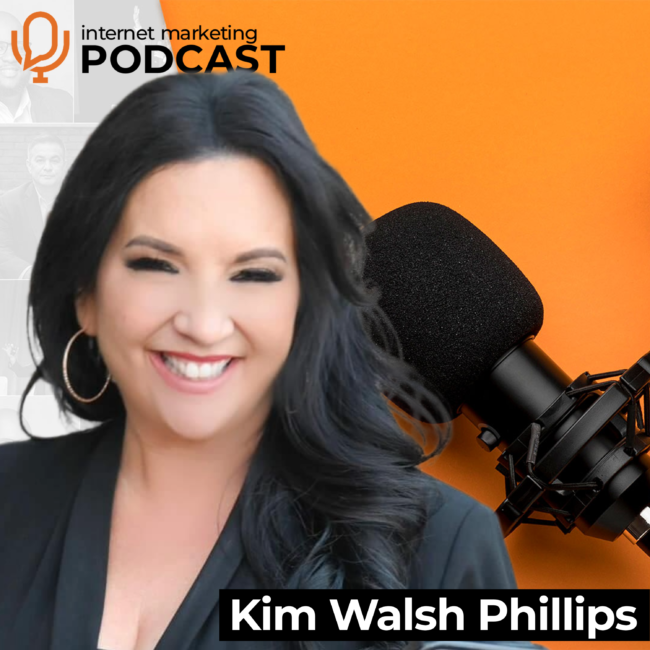
About this Podcast:
Today’s guest is Kim Walsh Phillips, a bestselling author, entrepreneur, and speaker who helps business owners grow through powerful messaging and high converting talks. Kim has built multiple successful businesses, worked with major brands, and is known for helping entrepreneurs turn their story, expertise, and stage presence into real revenue.
Episode Transcript:
Editor:
Today's guest is Kim Walsh Phillips, a bestselling author, entrepreneur, and speaker who helps business owners grow through powerful messaging and high converting talks. Kim has built multiple successful businesses, worked with major brands, and is known for helping entrepreneurs turn their story, expertise, and stage presence into real revenue. Kim, it is great to have you with us.Kim Walsh Phillips:
Oh, it's so great to be with you.Editor:
You are so famous for the million dollar talk and I know we're going to get into the framework of that maybe a little later, but maybe you could start by telling us how you got into this world in the first place.Kim Walsh Phillips:
I have always loved speaking since I was little, little, little. I was in the front of the room doing some kind of presentation, and then ended up being student council president and on the speech team. It was something I enjoyed back from my theatre background. 85% of my body is made up of the need for applause, that it's like Tinkerbell's light shines when I hear people cheer. And so naturally I started doing it to grow my business. I would get invited places to speak, and it was great, but it would always be just so that I would hope at the end of my talk someone would walk up to me and say, "I love what you said. How can we work together?" And it was great when it happened, but it was painful when it didn't. And then I realised that if I used some strategies to make it less based on hope, but more on strategic positioning, that I could turn talks into profit.Kim Walsh Phillips:
And so I switched up the way I do my talks to not just be a great story but be a story that drives people to a call to action, and it dramatically changed the way I did my business. I could grow, I could go speak on stages, which I loved doing, and I could use it each time to bring in clients. And then people started coming to me saying, "How do you do that? How could you be entertaining and drive business in at the same time?" So we started working with some of our elite clients to do the same for them and they had that same success, taking a talk that is entertaining and turning it into profits.Editor:
Can you remember the first time this happened for you, Kim? Where were you and how did it feel at that point?Kim Walsh Phillips:
I do. I had just taught myself basically how to do it by I bought a course, and they spent more time arguing in the course about whether you should use overhead projectors or a PowerPoint, so that didn't work. So I started going to people's events and watching webinars and I created a blueprint for myself. And the first time I ever tried it, I had 32 people in the room and I gave my speak to sell talk and 28 of them took my offer. And as I sat in the car afterwards, I had these tears streaming down my face because it was more money I'd ever generated in one hour, like more than I had generated the whole year before. And I literally went from the day before being $55,000 in debt to making enough profit to pay that off and to propel our business forward.Kim Walsh Phillips:
And the beautiful thing about it was I knew then I had finally cracked the code, that I didn't have to keep relying on hope, I could drive business in. And it doesn't even need to be a big room. That first room was 32 people. It's just that you need to put strategic positioning in place so that you could drive people into the sale.Editor:
I can imagine that was a real pinch yourself type of moment, Kim, when that happened.Kim Walsh Phillips:
It was.Editor:
And what were the early challenges maybe that you faced when you first got started? Was it your own self-doubt or were you just straight out of the gate, okay, I'm going to do this and I'm going to make sure I'm successful?Kim Walsh Phillips:
I think both things. I had a desire to do something different. So that was my first thing. I knew I enjoyed speaking, but I did not enjoy hoping and praying that clients would pay us enough to make payroll. One time I had to hawk my engagement ring in order to make payroll because things were so hard in the beginning of my company. So I knew I need to do something different and I knew that other people were doing it because I had seen them do it from the stage. I just knew I needed to figure out how. And the thing about speaking from stage is when you're trying it and you're testing it, you're doing it in real time in front of people. So there's this fear, what if they don't like me? What if this doesn't work?Kim Walsh Phillips:
But I already knew that what I was doing wasn't working.Kim Walsh Phillips:
So the way I positioned my mindset was I'm just going to get curious. Itwasn't that I went into it thinking this either is going to work or it's going to fail or it's going to be successful. I put on a mindset of, I'm going to get curious to see what would happen if I tried it. And that took all the pressure off. And now every time I speak, I've spoken on thousands of stages since then, I test something else and I just operate in a mindset of curiosity. Let me see if the audience would laugh here. Let me see if they're quicker to enrol. Let me see if we get more retention if we try this thing. And one of my favourite things is operating like a scientist to see how they respond. My favourite quote is, "In God I trust, everyone else bring data." And so I position myself as a data scientist in my mindset so it's not win or lose. It's just let's see what we can find out.Editor:
Now obviously this all converged into the million dollar talk. It's what you're famous for, as I mentioned in the introduction. Maybe you could just talk us through that for anybody who's not discovered the million dollar talk before.Kim Walsh Phillips:
Absolutely. It came from a time I was on stage and I was speaking to a group of IT professionals. So they're naturally introverts, and I was selling a product to get them to speak on stage and on camera. So I'm trying to get a group of people who've never done a thing before, don't want to do the thing, never woke up wanting to do the thing, to get them to take action. And the process I followed there is what you always want to do. You want to start with the story that tells them a before, a during, and an after that they can relate to. So I told the story of struggling, waiting on word of mouth and referrals, and how that transferred into unlocking a process to automatically generate more clients, and that's the system we have today. So that's step one.Kim Walsh Phillips:
Step two is you share with them a four-step framework, because it's something that they can follow, and you can own so they need to do it through you, so mine was speak, and then you naturally transition that into a call to action. So the invitation becomes a natural part of the presentation. It doesn't feel like a sale. And the transition statement that you use early in the presentation, you tell your audience, "I'm just going to give you this presentation. I know you're wondering if I'm going to make you an invitation at the end, and I am, so I want you to know that, but you're going to know when I make you that invitation. In fact, when I get to that part in the presentation, I'm going to ask you if I have your permission to make you an invitation. And if I've given you enough value by that point, you'll say yes and I'll share it with you. But if I haven't, you'll say no and we'll end the talk then. Sound good?"Kim Walsh Phillips:
And they're like, "Yes." So now they can play full out, and they can be excited and relaxed and not worried that I'm selling them something. And then when we get to the invitation part, I ask them, "Did I give you enough value to make you an invitation right now?" And when the audience says, "Yes," now they're asking for the invitation versus you pushing something to sell to them. And so now they feel in control. And a buyer always wants to feel like they're in control because it feels really uncomfortable if something's being forced on them, but feels really good if they're asking for it. So after the invitation, I made the invitation and they said yes, they wanted it.Kim Walsh Phillips:
And then the most important thing is you need to make it urgent. It has to be urgent because buyers are separated into two categories. There are shakers, they rock back and forth thinking about making a purchase, and there are movers, they are going to move into massive action right now. You need a few movers in the beginning of making your invitation to give the shakers confidence that they're making the right decision. So in order to get someone to move, you need to give a time-sensitive call to action. So we made a time-sensitive call to action that the first 27 people were going to get a big bonus of a one-on-one session with us, and then, no one was moving out of their seat. So in real time you can pivot. And I said, "Okay, a special bonus for the first person." And literally I got trampled, so much so that I got pushed to the ground. So many people jumped up on the stage and we had so many people come in for the offer that we generated $1.25 million in revenue in that one hour talk.Editor:
That's amazing. What would you say is the biggest difference between a presentation that inspires and one that actually then goes on to convert as well? Is there anything that you've identified?Kim Walsh Phillips:
A talk that inspires is one of the most dangerous things that you could ever do because when you get your audience inspired without giving them a way to take action, you're doing them a disservice. And most people think, oh, I don't want to make a pitch because they might not like me or I'm not serving them. But if you get them excited, filled with hope, and then you don't tell them how to do it, that's really dangerous. I was actually at an event. I heard an incredible speaker. She's really famous. She told her story and it was a bit traumatic and it unlocked a little bit of trauma for me, and I'm sitting there kind of shaking and at the end of her talk, she got applause. And I thought, "What do I do with this feeling? Aren't you going to give me a way to solve it?"Kim Walsh Phillips:
The best thing you can do for your audience is align your talk with a way that they can solve it. And when you have those two things connected, nothing in your story that you can't solve, nothing in your examples that you can't solve, you're doing a beautiful gift for your audience. You get them inspired, you give them hope, and then you give them a way to get that solved. A beautiful way to start is just by presenting your idea, opportunity, story to people you already have access to. So maybe you're in a school group and they invite speakers in to speak to a school group and you already know these individuals, or maybe you're in the Rotary Club or the chamber and there's just opportunities to share within a meeting. That's a wonderful way to begin.Kim Walsh Phillips:
And then you can take your practising to online. You can try it by recording it as a video. You don't have to share the video online to start, but then you can post it to LinkedIn or to YouTube or to Facebook or Instagram, and then you could start trying live posting so you're giving your talk in that way. So the more comfortable you get, the better. But here's the thing, the fastest path to success is finding a blueprint of somebody who's already done the thing you want to do. So I recommend anybody who wants to get more business by speaking, find a coach, a blueprint, a mentor who has done that very thing and follow the pathway, not just speaking for speaking sake. There's a lot of people who can teach you how to speak, and that's fantastic. But if you want to use speaking to grow your business, find someone who's done that before and then get a copy of the blueprint as the fastest path to getting it done for yourself.Editor:
Obviously you focused a lot on storytelling. You tell some amazing stories from the stage, Kim. How important is it to use a story when you are making a presentation? Do you think it's always necessary, or sometimes, or not at all?Kim Walsh Phillips:
Always... That was a good setup question. Always necessary. You want a story for the beginning of your talk, you want a story after every step in your framework, you want stories to be shared in your clothes. It's one thing to give facts, figures, information, but they don't become real until you make them through storytelling. And so stories are a vital part. Now, you have to have enough constraint to only tell stories that make sense for the audience you're speaking to on the topic you're speaking about in order for them to relate to it and see themselves in that story. You might have a great story about this time the kindergarten teacher did not give you a cookie. That should not be in the talk if that doesn't have to do with your topic. This is not performing, this is persuasion. And so you only tell stories that make sense for the topic that you're trying to get your audience to move towards.Editor:
And you've also been a big proponent in this movement to inspire business owners to get up on stage, talk about their business, not hide behind their keyboards or just hide on a webinar to actually get out there and do it. What motivates you to do this, Kim? What gets you out of bed in the morning?Kim Walsh Phillips:
I'm on a mission to get one million clients because every single client I work with impacts tens, hundreds of thousands of people. So my fast path to impact is to get as many clients as I possibly can and I won't stop till I hit a million. And so by speaking on stage, I get to get in front of other people's audiences that have already gathered, I get instant authority positioning, and for me, it's the fastest path to achieving my purpose of why I'm here on this earth.Editor:
I love that. Well, finally, for someone who's listening to this who wants to create a talk that actually drives revenue, what is the first step that you think they should take this week or today?Kim Walsh Phillips:
Unlock a story of how you went from before things... Before you knew what you knew, what was life like? What is it that you discovered? What action did you take? And what does life look like now? Just write that out and then record it as a video and post it online. That's you telling your story in a meaningful way that your audience can connect to, and that's the fastest path to driving in results from the stage. And it's a beautiful first step in getting comfortable telling your story in order to make an impact and generate more income.Editor:
That's amazing. And once again, for anybody who wants to find out more about you and connect with you directly, Kim, where do we need to go to do that?Kim Walsh Phillips:
Connect with me on LinkedIn. That would be the best place. And I have three names, so there's only one of me, Kim Walsh Phillips. That's Kim, W-A-L-S-H P-H-I-L-L-I-P-S. Kim Walsh Phillips. Connect with me on LinkedIn and we can have a conversation about what best free resource I can send you, whether it's growing your online profile, building more audience, generating more sales, or getting on more stages.Editor:
That's amazing. Kim, thank you so much for your time today. It's been an absolute pleasure.Kim Walsh Phillips:
Thanks for having me-
Meet your hosts:
Episode 161
Paul Finck
Episode 158
Alan Clayton Interview
Episode 155
Travis Lee Interview
Episode 129
Mr. Kelly Cole Interview
Episode 181